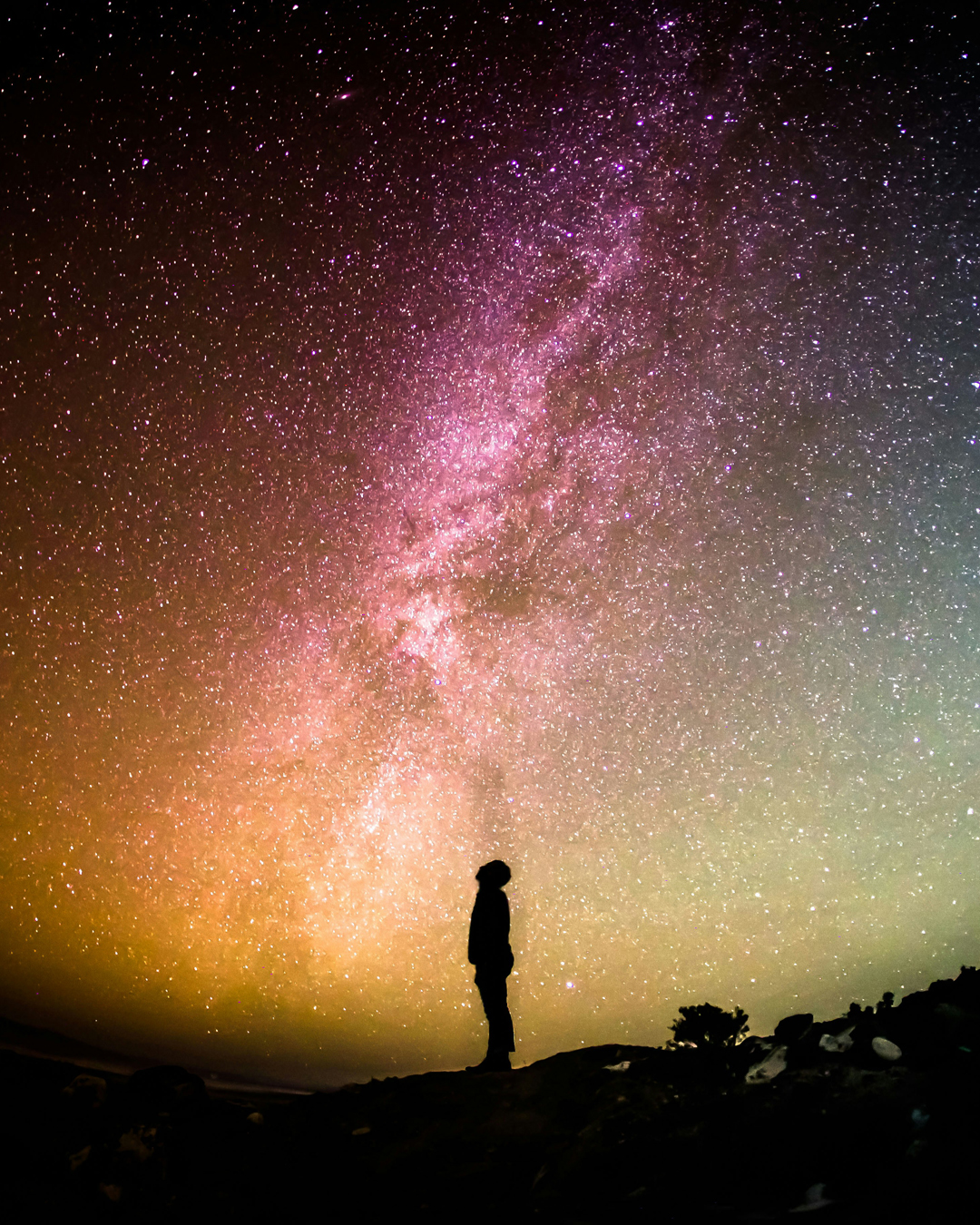
No one would dare to disturb the goddess. We could look, worship and count our meager days here on Earth by her changing appearance, that is all. The ones like Anaxagoras, who suggested that the deity is a mere rock unable to even shine by herself, faced imprisonment and exile. Those in the East, who had no faith in the divine woman with many names, started to put her in numbers. Calculating, observing, measuring. And soon, the goddess was no more. No more Selene, mighty daughter of the Titans, connected with other forces in lunar sisterhood. She became the Moon.
One might think that a transformation from the almighty power intertwined with Olympus to yet another object in the sky would be a downgrade and rightfully so – if we look at it from Selene’s perspective. What was an unquestionable decline for her was also the ascent of human curiosity; a strive to reach for what was previously protected by sacrum. No mythological wrath could punish us for looking directly at the Moon’s face through telescopes, drawing maps of its surface and naming its craters, embracing and adopting it as ours. Ours to observe, admire and conquer. The journey to the Moon and back had started. We gracefully allowed Gods and Goddesses to accompany us through words. Would Apollo be flattered or offended to have a human mission named after him? Would Luna confirm that she occasionally turned men into lunatics? Would Selena take an interest in selenology?
Why are we so fond of the Moon? It was never just another object in the sky for us. Deep down, we might think that if we know everything there is to know about our moon, we get to know everything about ourselves. It is to us what Luna was to Selene – an experience transferred under a different name. The Moon is an ultimate object – it has the power to unite within it and transgress religion, science and art. The three mighty powers that have been stirring mortals since the dawn of time. The Moon was there with us, seemingly doing nothing tangible, nothing more meaningful than fueling fear through werewolves and witches. So, what was it for? That comrade in darkness. If this lonely rock could have a purpose, maybe we have it too. We started to dig deeper and eventually dug into the Moon’s surface.
With the recent NASA’s Artemis missions, many ask – why are we going back? Well, perhaps we have never left. We seem to be unable to forget about figuring out our satellite. Man on the Moon captures our collective imagination like nothing else. Sixty years after taking a giant leap for mankind, there is still so much to be discovered and conquered. The original NASA’s description of the endeavor states: “We will collaborate with commercial and international partners and establish the first long-term presence on the Moon. Then, we will use what we learn on and around the Moon to take the next giant leap: sending the first astronauts to Mars.” It also mentions creating a base camp on the surface, utilizing resources, establishing power plants and expanding supply chains. How very fitting that we moved from romantic Apollo – the God of poetry, to his twin sister Artemis – the Goddess of the hunt.
This world teaches us that everything has its purpose, and we are able to discover it through our abilities and means. So, what on Moon is ours? Well, maybe it is not a single given thing. When you use a receipt as a bookmark, you give it a new purpose. Just as the Moon, once an ultimate goal, became just a stop on the further way. What is sure is that we needed a lot of patience and improvements, progress and failures to be where we are now and to know what we know about our brother in orbit. No matter how much we will still learn, moonlit nights will be there for poets and lovers. It does not matter what scientists say, we will still claim that we cannot sleep at full moon. There are witches around us today who prepare moon water. The Moon is for everybody to see, interpret and appreciate individually. No one will ever own it, we even made sure about it in international law.
We all have a single moon and therefore each of us has one for ourselves. Life and the search for its purpose is ultimately a lonely task, but we have this one silent companion. We are just like two kids at the playground, destined to become friends because no one else wants to play with us. Would moons of other planets understand ours? Just imagine how many people appeared in your orbit by simple collision. Yes, you can be just a little rock but if you are positioned well, in the right place at the right time, you can end up moving oceans. You may think that your presence is not important, but your disappearance would disturb someone’s ecosystem to catastrophic proportions. You may shine by reflecting the light of something much more powerful than yourself, it does not mean that your glow is not useful. One of humankind’s eyes is constantly set on the Earth and the other on outer space, because, at some point, we need to get separated from our globe and venture a little bit further.
The never-ending search is a blessing and a curse. We are really just lost humans in a vast universe on one miracle blue marble circling the sun, with another space rock for a friend. Maybe that is why we want to be great, to find a purpose, and goal and figure out our destiny – to live up to the luck of even being here and even out the lack of significance of our existence. Soon, with the help of the Moon, we will travel to and love to Mars and back. Godspeed.
Photo: Jasper Benning
Read our “Camouflage” issue in full
RAWGUE.’s 4th issue delved into the grey, moody, and cold atmosphere of winter. Yet it did not sink into the depths of madness or depression. Instead, it embraced this season of hibernation, allowing 31 artists from all over the world to present their timid work beneath a veil of quiet beauty.